
After certain brain surgeries—such as removing a tumor, treating bleeding, or relieving brain swelling—a portion of the skull may be temporarily removed.
Once the brain has recovered, we perform a procedure called cranioplasty, which means restoring the skull.
One of the most common questions I receive is
“What material will you use to repair my skull?”
The answer depends on several factors. Let’s walk through the options in a simple way.
Why Cranioplasty Matters
Cranioplasty is not just cosmetic.
It helps:
- Protect the brain
- Restore normal pressure dynamics
- Improve neurological function in some patients
- Improve appearance and confidence
The Main Options
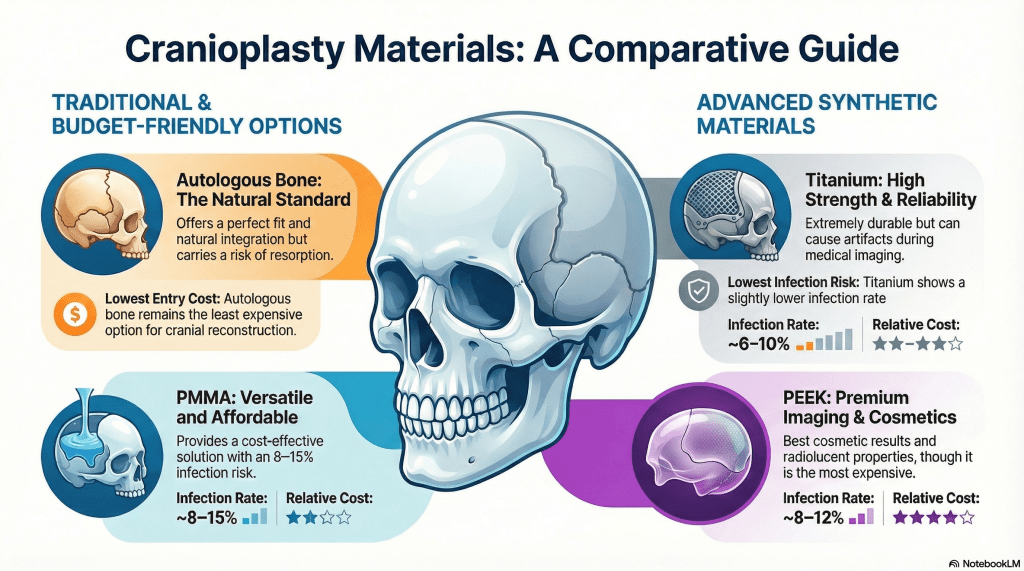
1. Your Own Bone (Autologous Bone)
If your bone flap was preserved, we may be able to put it back.
Advantages
- Natural tissue
- Perfect anatomical fit
- No artificial material
Limitations
- The bone can gradually dissolve (resorption) over time
- May require another surgery if that happens
👉 Best for: selected patients with well-preserved bone and lower long-term risk. I also prefer to use autologous bone in children.
2. PMMA (Medical Bone Cement)
A commonly used synthetic material.
Advantages
- Affordable
- Can be shaped to fit the defect (It’s moldable)
- No interference with CT/MRI scans
Limitations
- Slightly higher complication rate in some studies
- Less durable than metal
- The shape of your bone will depend mostly on my molding skill
👉 Best for: patients who want a cost-effective and reliable option
3. Titanium (Metal Mesh or Plate)
A strong and widely used material.
Advantages
- Very durable
- Reliable long-term
- Lower infection risk in many studies
Limitations
- Can interfere with imaging (CT/MRI artifact)
- May be felt under thin skin in some patients
- If you need further radiotherapy, radiosurgery >> this might not be the right option
👉 Best for: patients who need a strong, dependable reconstruction
4. PEEK (Custom 3D Implant)
A modern, patient-specific implant designed from your CT scan.
Advantages
- Excellent cosmetic result
- Perfect fit for complex skull shapes
- No imaging interference
Limitations
- More expensive
- Requires preoperative planning
👉 Best for: patients who prioritize cosmetic outcome and precision
What About Infection Risk?
Many patients worry about infection.
In reality:
- All synthetic materials have quite similar infection rates (roughly 5–15%)
- Autologous bones depend largely on how they were stored. If the store and cleaning process were not done properly, there might be some risk of infection.
- The most important factors are:
- Timing of surgery
- Condition of the scalp
- Previous infection
- Overall health
👉 In other words:
The patient and surgical conditions matter more than the material itself.
So… Which One Is Best?
There is no single “best” material.
It depends on:
- Your medical condition
- Size and location of the skull defect
- Cosmetic expectations
- Budget
- Previous surgeries or infections
My Approach
When I discuss cranioplasty with patients, I usually simplify it like this:
- Natural option → your own bone
- Budget option → PMMA
- Strong and cosmetic option → titanium
- Cosmetic, no imaging interference option → PEEK
Then we decide together based on what fits you best.
Final Thought
Cranioplasty is more than just “closing the skull.”
It is about restoring protection, function, and confidence.
Choosing the right material is part of that journey—
and it should always be personalized.
 Ekkapot Jitpun, MD
Leave a comment