Movement Recovery After Brain Injury
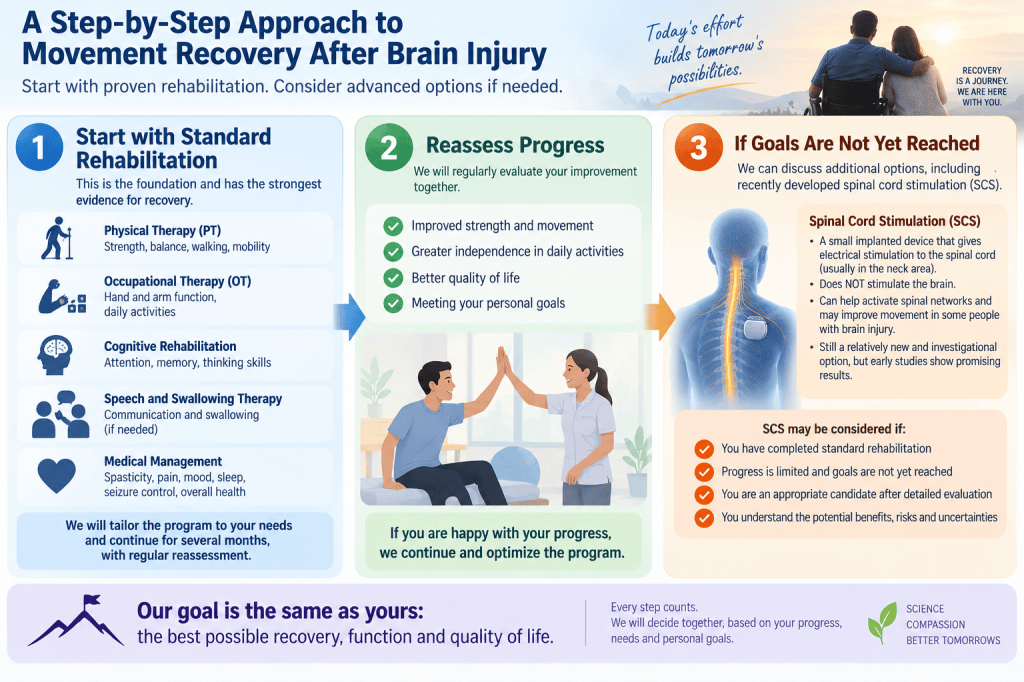
Start with standard rehabilitation. Measure progress carefully. If important goals remain unmet, newer options such as spinal cord stimulation (SCS) may be discussed in selected patients.
Start with standard rehabilitation
This remains the foundation of recovery and has the strongest evidence.
✓ Physical therapy: strength, balance, standing, walking
✓ Occupational therapy: arm, hand and daily activities
✓ Task-specific, repetitive practice
✓ Spasticity and pain treatment when needed
✓ Cognitive, speech and swallowing therapy when appropriate
✓ Good seizure control and general medical care
Reassess progress
Recovery should be judged against the goals that matter to the patient and family.
✓ Is strength improving?
✓ Is walking, transfer or hand use improving?
✓ Is the patient more independent?
✓ Are personal goals being reached?
✓ Are there treatable barriers such as spasticity, contracture, pain or poor seizure control?
If important goals are still not reached
Additional options can be discussed. One recently developed option is epidural spinal cord stimulation (SCS).
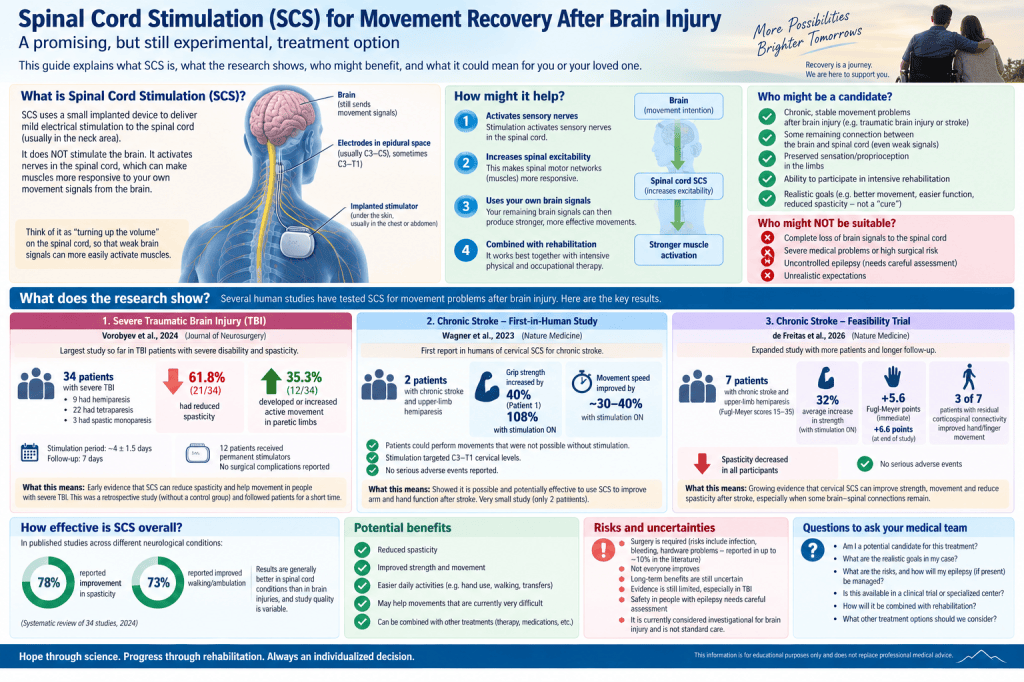
✓ SCS does not repair the injured brain
✓ It stimulates spinal sensory pathways and motor networks
✓ It may help remaining brain signals activate muscles more effectively
✓ It is usually combined with intensive rehabilitation
✓ A temporary stimulation trial may be considered before a permanent implant, depending on the clinical protocol
The goal is the best possible recovery, independence and quality of life. SCS is only one possible tool if conventional rehabilitation does not achieve enough meaningful improvement.
Explore the pathway
Click each question to open it.
How long should standard rehabilitation be tried?
What should be measured before considering SCS?
Who may be a reasonable candidate for an SCS discussion?
What if the patient has post-traumatic seizures?
Is SCS proven to restore normal movement?
What do early human studies show?
These numbers are encouraging, but they should be interpreted as early research, not a guarantee of benefit.
2024 retrospective series; 9 had hemiparesis.
61.8% had reduced spasticity.
35.3% developed or increased active movement in paretic limbs.
2023 first-in-human cervical SCS study.
Grip strength increased by about 40% in one participant and 108% in the other during stimulation; movement speed improved about 30–40%.
2026 feasibility study.
Average strength increased 32% with stimulation. Immediate Fugl-Meyer improvement averaged +5.6 points, with +6.6 points at study end.
Continue standard rehabilitation when…
✓ The patient is still improving
✓ Meaningful goals are being reached
✓ There are modifiable problems that have not yet been optimized
✓ The expected benefit of an experimental procedure is uncertain
Discuss advanced options when…
✓ Deficits are chronic and stable
✓ Appropriate rehabilitation has been tried
✓ Important goals remain unmet
✓ The patient understands the uncertainty
✓ A specialist believes there is a reasonable biological and functional basis for a trial
Selected References
- Vorobyev AA, et al. Clinical Outcome After Epidural Spinal Cord Stimulation in Patients With Severe Traumatic Brain Injury. 2024.
- Wagner FB, et al. Epidural stimulation of the cervical spinal cord for post-stroke upper-limb paresis. Nature Medicine. 2023.
- de Freitas et al. Cervical epidural spinal cord stimulation for chronic post-stroke upper-limb paresis: feasibility study. Nature Medicine. 2026.


Leave a Reply